
Innovation without exploitation — you own your data.
Liberty Scorecard: Rights • Privacy • Innovation
The problem
Valuable data is either locked away in silos or exploited without meaningful consent. Too often, “consent” is buried in fine print, reused for unrelated purposes, and hard to revoke in practice. The result is lost trust, higher risk, and slower innovation.
The principle
You should own your data. Permission should be specific, revocable, and enforceable—not a one-time checkbox. If consent is withdrawn, future processing should stop, and any continued use should leave evidence.
This matches a strong best-practice benchmark: consent should be as easy to withdraw as it is to give.
The solution: Consent Audit Trails
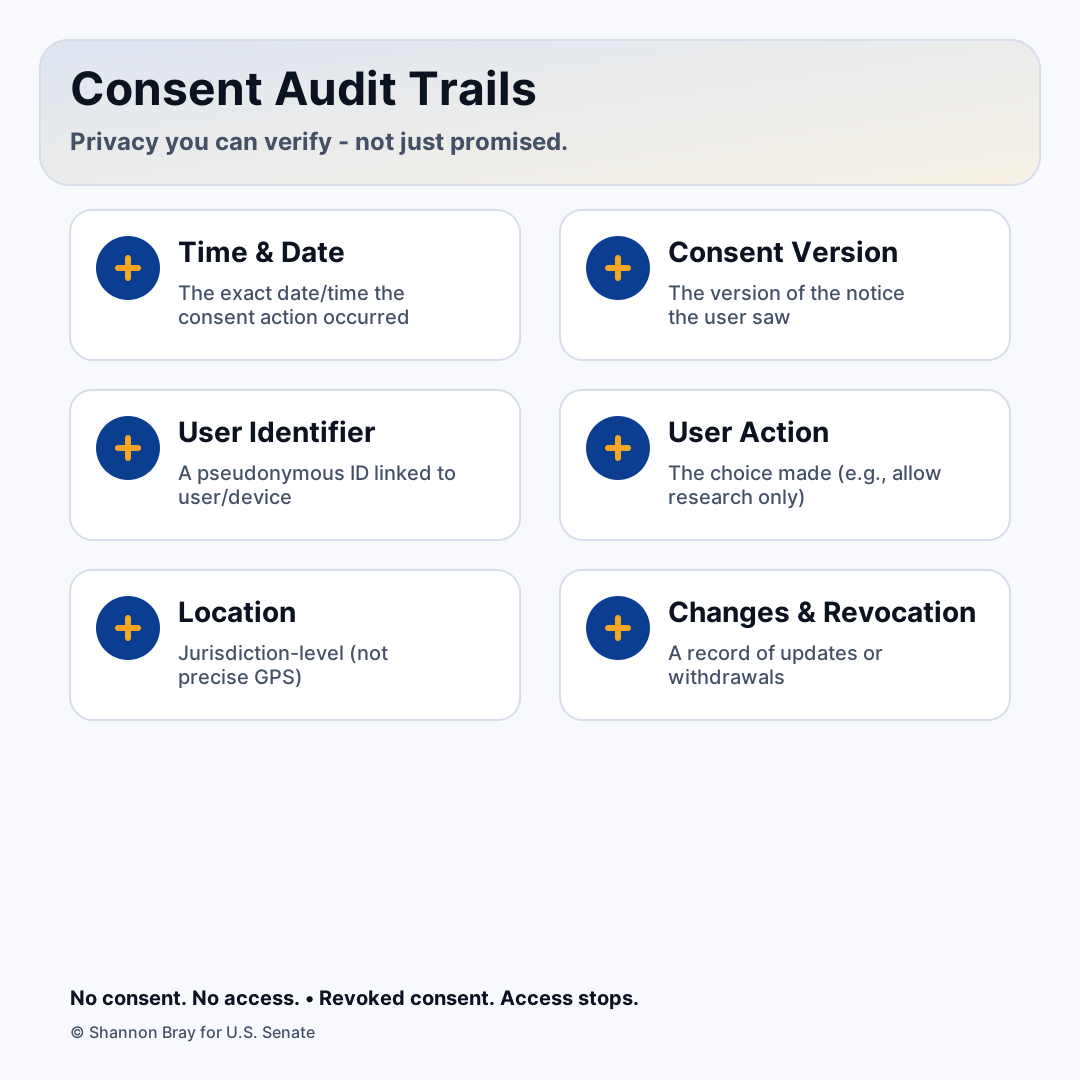
A consent audit trail is a tamper-evident record that ties every use of personal data to a specific permission you granted. It turns consent into something enforceable:
- No valid consent → no access.
- Revoked consent → future access stops.
- Ignored consent → violations leave proof and trigger penalties.
How consent audit trails work (step by step)
- Grant: You approve a specific use for a specific purpose (what data, what purpose, who can use it, and for how long).
- Use: Data can only be used within those limits—preferably using “minimum necessary” access and privacy risk controls.
- Log: Every access is recorded (who, when, what scope, and what consent it relied on). Standardized “consent receipts” can provide human-readable proof.
- Revoke: You can withdraw permission without friction.
- Enforce: Future access stops via expiring authorization, token/key invalidation, and continuous checks—backed by auditable logs.
Technical accuracy note: A system can reliably stop future access when you revoke consent, but it cannot “un-copy” data already exported. That’s why the best designs minimize raw-data copying and favor secure, controlled processing where possible (risk-based privacy engineering).
Compare: Today vs This Model
| Today’s data system | Consent audit trail model |
|---|---|
| Consent buried in fine print | Consent is explicit, purpose-specific, and time-bounded |
| One-time opt-in that’s hard to undo | Revocation is easy and enforceable for future use |
| Users can’t see data use | Every access is logged and attributable (audit trail) |
| Violations are hard to prove | Violations leave tamper-evident evidence for enforcement |
| Broad copying and resale incentives | Minimize raw export; prefer controlled processing and privacy risk controls |
FAQ
No. Privacy policies describe intent. Consent audit trails enforce behavior: each use must match a permission, each use is logged, and revocation stops future access.
Revocation reliably stops future access, but no system can un-copy data already exported. That’s why we push designs that minimize copying and rely on enforceable controls plus provable audit logs.
Yes. Standards exist for user-managed authorization patterns (UMA) and for standardized records of consent (consent receipts).
AI can still improve without exploiting people. Training should be a disclosed purpose, logged, and future training should stop after revocation. Privacy-preserving methods like federated learning and secure processing environments can reduce raw data exposure.
Draft Legislative Language (Policy Concept)
This is a policy draft to show enforceable requirements. Final bill text would be refined through counsel and committee process.
Section 1. Definitions
- Personal Data: data reasonably linkable to an individual or device.
- Consent Audit Trail: a tamper-evident log that links each access/processing event to a specific permission granted by the data subject.
Section 2. Purpose-bound, affirmative consent
Covered entities must obtain affirmative, purpose-specific consent stating: data categories, purpose (including AI training if applicable), recipient identity, duration, and limits on sharing/reuse. Consent withdrawal must be as easy as consent granting.
Section 3. Mandatory logging
All access/processing must be logged in a tamper-evident system referencing the applicable consent record (who, when, scope, and purpose). Consent receipts may satisfy standardized proof-of-consent requirements.
Section 4. Revocation enforcement
Upon revocation, covered entities must stop future access and invalidate related authorizations (tokens/keys/permissions). Continued use must be logged as a violation.
Section 5. Transparency
Individuals must have a plain-language dashboard showing active consents, access history, and revocation status.
Section 6. Enforcement
Use without valid consent, or use after revocation, constitutes a violation subject to civil penalties and enhanced penalties for knowing or repeated violations.
Section 7. Standards & interoperability
Regulators may recognize standards-based authorization approaches (e.g., UMA) to promote interoperable, user-controlled consent across services.
For more information, see: How this applies to AI Training
To review the research, see: Encrypted, Consent-Driven Data Sharing: A Framework for Innovation Without Exploitation
References
- GDPR Article 7 (withdrawal as easy as giving consent).
- NIST Privacy Framework (privacy risk management and engineering controls).
- OECD Privacy Principles (purpose specification / use limitation).
- Kantara Consent Receipt Specification (standardized, human-readable consent records).
- UMA 2.0 grant (user-managed authorization patterns).
- NIST Privacy-Enhancing Cryptography (FHE/MPC context).
- Federated Learning (McMahan et al.).
- Trusted Execution Environments (confidential computing).